Tuesday, September 09, 2008

No New Missouri Polls Yet

While it appears there is a wave of new polling coming out of some battleground states (Ohio and Virginia, for example), there is little news from Missouri.

All we can currently go on were polls that showed a steady lead for McCain
(48% to 44%) right into the beginning of August. If the convention bounce that is showing up in national polls trickles down to us (as it is likely to do) then it is hard to see that gap narrowing at all.

I have to again say that if anyone is seeking in-depth, insightful coverage of political polling-from the latest results to what it means-Pollster.com is the place to go. I say this mostly because I lean on them for a great deal of coverage. They maintain an up-to-date list of the latest polls, run aggregate numbers and analyze what's going on behind the numbers. It's like having your own private pollster.

- Murphy

Monday, September 08, 2008

Why Georgia Really Means...

Recent events in the caucuses has meant that Georgia may mean more than Bulldog football for many Americans.

The effort by the Eurasian nation of Georgia to repatriate the breakaway region of South Ossetia by force and its consequent rebuffing by Russian forces (claiming to stand in defense of Ossetian independence), has reignited concerns about Russian efforts to reassert itself in the world, and has injected itself into U.S. Presidential politics.

Following Russia's brushing aside of the U.S.-advised Georgian forces (one thousand U.S. troops were in-country training the Georgian military only months ago), and their de-facto control of the country, the subject has, surprisingly, drifted off the cable news tickers and newspaper front pages.

Despite the quiet, the Russian-Georgian conflict represents a shift in the power and influence that has yet to be absorbed by many in this country.

George Friedman, of the private intelligence group Stratfor, has penned a fascinating and quick read in the New York Review of Books that lays out why Georgia really matters, and what it says about the state of American power in the world.

...the United States, along with other countries, has viewed Russia through the prism of the 1990s, when its military was in shambles and its government was paralyzed. The United States has not seen Russia make a decisive military move beyond its borders since the Afghan war of the 1970s and 1980s. The Russians had systematically avoided such moves for years. The United States had assumed that they would not risk the consequences of an invasion. 
If that was the case, then it points to the central reality of this situation: the Russians had changed dramatically, along with the balance of power in the region. They welcomed the opportunity to drive home the new reality, which was that they could invade Georgia, and the United States and Europe could not meaningfully respond. They did not view the invasion as risky. Militarily, there was no force to counter them. Economically, Russia is an energy exporter doing quite well—indeed, the Europeans need Russian energy even more than the Russians need to sell it to them. Politically, as we shall see, the Americans need the Russians more than the Russians need the Americans. Moscow's calculus was that this was the moment to strike. The Russians had been building up to it for months, and they struck. 

The rest of the article explains the complex relationship the U.S. has with the Russians, how the Europeans are in no position to argue, the general sense of dismissal towards Russian potential to project strength, Russia's own rise to economic prominence due to energy resources, and the fact that the U.S. has tied itself down tight in Iraq.

In other words, the Russians have backed the Americans into a corner. The Europeans, who for the most part lack expeditionary military forces and are dependent upon Russian energy exports, have even fewer options. If nothing else happens, the Russians will have demonstrated that though they are not a global power by any means, they have resumed their role as a significant regional power with lots of nuclear weapons and an economy that is less shabby now than in the past. Russia has also compelled every state on its periphery to reevaluate its position relative to Moscow. That is what the Russians wanted to demonstrate, and they have demonstrated it.

Georgia has been pushing for entrance into NATO, the military alliance that stood in opposition to the Soviet Union during the Cold War. Recent acceptance into NATO by other countries formerly under Russian influence or control-such as Poland-have helped fuel the growing tension between a re-emergent Russian under former Russian President Vladimir Putin, and the West.

Handling a more confident and powerful Russian bear will be a major challenge for the next President. While President Bill Clinton and President George W. Bush's father skillfully managed the turbulent breakup of the Soviet Union, the younger Bush has been able to tend to it only a fraction of the time. Meanwhile Putin was slowly regrouping the strings of power. Bush was happy to welcome the Orange Revolution in Ukraine (which has since lost its luster as the nations splits over its decision to lean east or west) and the Rose Revolution in Georgia. 

Yet neither nation has turned into a bastion of freedom and both are looking askance at Bush while keeping one eye on the bear sitting next to them.

Far from a wave of new democracies in the former Soviet Sphere, we are now left with a newly assertive Russia, proud to reclaim its former spheres of influence (those were fighting words in the Cold War) and happily thumbing their nose at the United States as we spend billions in Iraq. 

- Murphy

Saturday, September 06, 2008

David Frum: What matters

David Frum, a conservative author and former speechwriter for President Bush, talks about why it's important for Palin to be out in front of the debate over her qualifications to be VP as well as why it's essential to be able to make your case forcefully, and not just preach to the choir.

A question I am often asked when I give talks or lectures is: Why did the Bush communication effort end so badly? How did an administration that once commanded such public support end by losing all ability to make its case?

My answer is that the ultimate failure was encoded into the initial success. The president's communication team - of which Nicole Wallace was an important part - shared the same disdain of "elites" that permeates so much of my pro-Palin correspondence. It was not just the media elite that they disregarded. (Who could blame them for that?) It was the policy elite too. When the president wished to advocate, eg a tax cut, he did not argue his case before the Detroit Economic Club or send a surrogate to Jackson Hole. He made a rally speech before cheering supporters. That made for effective soundbites and exciting images. But it abdicated any effort to make an argument that could convince people who were not predisposed to be convinced.

- Murphy

Palin Also In the Freezer

The McCain campaign has let it be known that his VP pick, Gov. Sarah Palin, will be incommunicado for the time being.

Perhaps this is a chance for the campaign to find out more about Palin straight from her instead of the media.

A well-caffeinated college intern with Google and a long-distance phone card could have uncovered more about Palin than the McCain campaign appears to have found before announcing her place on the ticket.

One of the most important role a President has is the appointment of key officials: cabinet officers, military commanders, federal judges. 

How does their preparation for the VP position (the Presidential back-up if you will) reflect on McCain's competency when it comes to decision-making? 

- Murphy

Friday, September 05, 2008

Fannie and Freddie Frozen?

(via Washington Monthly) The New York Times is reporting that Freddie Mac and Fannie Mae  have been put on notice that the government intends to take control of the two mortgage giants soon. The head of the Federal Reserve, Ben Bernanke, and Treasury Secretary Paulson, Jr., have apparently decided they had given the companies enough time to clean up their books and restore investor confidence.

Effectively, the government is putting them into bankruptcy and cleaning house. The heads of both companies and their boards will all be replaced. The investors will see their stocks dwindle to nothing. The taxpayers, meanwhile, will be pickup up the tab as the companies are rebuilt; and hopefully confidence in the institutions will be rebuilt as well.

This is one of those "oh, nuts", moments economists were worried about. Why? Fannie and Freddie own or guarantee approximately 50% of the mortgage market, almost $6 trillion. While they are hamstrung by their efforts to rescue what is left of the company, they have not been performing their role of adding liquidity to the mortgage market, their appointed role since their inception (Fannie Mae in 1938 and Freddie Mac in 1970). Less liquidity means fewer loans which results in slower growth.

This move, one of the largest takeovers in history, is far from an example of an economy that is "fundamentally sound", as Sen. John McCain recently said.

Currently the economy is not providing a better life for most Americans. Productivity is up, but wages are stagnant, and job loses are growing. 

Whoever occupies the Oval Office, they will have to confront the shaky economic reality that many families struggle with every day. So far, McCain's comments on the economy do no relate to the world most people see; perhaps reflecting his admitted ignorance of economics. 

There are no perfect fixes, but reducing the burden on those making less, creating a more fair health care system, finding ways to encourage businesses to expand and hire more workers in this country, and not pretending their is no problem would be a good place to start.

- Murphy

Opening Up Wireless Internet?

Google, the ubiquitous internet search engine, has teamed up with several industry groups and non-profit media organizations–including the Wireless Innovation Alliance and Free Press–to press Congress to free up more of the wireless spectrum for wireless internet projects.

The spectrum in question, referred to as "white space" as it goes unused, resides alongside the spectrum used to broadcast television signals, specifically around channles 2 and 54. The new devices built to take advantage of this "white space" would transmit and receive on the unused portion of the spectrum. There are several ideas on how to do this effectively, either a central database the device would consult based on its location, or a more autonomous version in which the device determines which spectrum is clear on its own-most likely in the future.

Traditionally the Federal Communications Commission auctions off spectrum to the highest bidder. Thus, Verizon has a chunk, AT&T has a slice and so on.

Google and its partners want the spectrum to be released to the public as an "open" spectrum, meaning no one company controls the spectrum and all devices using the spectrum, such as WiFi devices, would be based on a standardized but open, non-proprietary platform.

The National Association of Broadcasters have expressed concern that allowing unfettered use of the spectrum would interfere with their broadcasts. Those in favor of opening up the spectrum, however, counter that the technology has been shown to work. Devices are still under development.

The concept of open access to a public resource like the electromagnetic spectrum is appealing. Expanding access will allow small developers to have the same access the multi-billion dollar companies–including Google and their fellow Alliance partners Dell and Microsoft.

In the past, allowing anyone unfettered ability to broadcast would wreak havoc on the ability to use the spectrum effectively. New technology, however, will allow more options to be squeezed out of the limited available spectrum.

A well designed system could allow greater access for individuals and small groups to the broadcast spectrum, creating a less hierarchical structure more akin to the internet and perhaps sparking a new explosion of innovation and growth.

For more on the Google plan, read Joel Johnson of BoinBoing.net's article on the proposal.

More: Google's advocacy website including a petition to lobby Congress and videos from internet users. Free Press's website on opening internet access.

- Murphy

Thursday, September 04, 2008

McCain's Speech

Sen. John McCain accepted his role as the Republican nominee with a speech that ranked among the better public appearances McCain has made this campaign. McCain has never been a polished speaker, and tonight was no exception. Yet it was a well prepared speech and, as such, counts as a plus in the speech column.

McCain's was a speech long on biography, short on policy and heavily sprinkled with buzz phrases. He regularly pressed his image as a contra-Washingtonian, an insider who chafed at the tony lifestyle of the national elite. Yet of the list of policy points McCain did touch upon, nothing seemed at all out of step with the Republican party platform: increased oil drilling, vouchers and reducing taxes (though he doesn't say whose taxes).

When it comes to McCain's own signature issue, earmarks, however, he is undercut by his own VP selection. Gov. Sarah Palin spent most of her political career ensuring her constituents received as much federal money as possible; including those funds that were to go towards the infamous "bridge to nowhere". The project-which Palin only spoke negatively about after it was canceled-never came to fruition, but the funds were sent to Alaska anyway and distributed.

The most compelling portion of the evening was Sen. McCain's own personal story. His experience in Vietnam is one that defies summation. His story is one that is not so far removed from some of the friends and family we are close to. While it is a history that many Americans see within their own families, it has taken on an almost totemic quality in the McCain campaign.

Following his military career, McCain decided to enter public life and run for office. It is on those terms that we should judge him. Did he support campaign finance reform and then abandon it? Did he interject himself in an international dispute between the United States and Russia over a country-Georgia-which had, until recently, kept McCain's foreign-policy advisor on retainer as a lobbyist? If McCain believes that needling Russia over the issue of Georgia's rebellious regions- thus reigniting conflicts Presidents George H. W. Bush, Bill Clinton, and George W. Bush have worked to mediate, and perhaps jeopardizing our efforts to mediate Iran's nuclear threat among other efforts-then it should be front and center in the debate.

It's unlikely McCain's seech gave anyone who wasn't already a supporter something to vie for. However, he did provide a counterpoint to Gov. Palin's red meat on Wednesday night. It may seem like a smart move, to contrast McCain as the moderater of the Republican fight points, but given that he has to moderate his own VP-usually considered a complimentary role-does not bode well for how his campaign views the heft at the top of the ticket.

Palin was a pick from deep in right field. Prior to her selection, and the resulting enthusiasm amongst the base, McCain was effectively dead in the water when it came to the several million conservative votes that kept President G. W. Bush in the White House for the past eight years. His speech might be enough to maintain his reputation as a moderate (despite the record his campaign is putting together), but if the ticket does make it to the Oval Office, it won't be due to McCain's persuasion.

- Murphy

Wednesday, September 03, 2008

Where The Angry Women At?


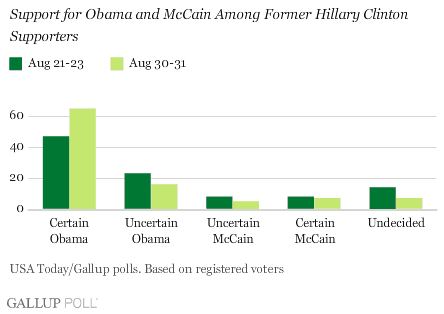
Despite weeks of breathless pontification over the fate of the Democratic party as women rendered it asunder in the wake of their heroine's loss we come to learn that, in the end, most Democratic party members behaved like-well-Democratic party members.

PRINCETON, NJ -- The Democratic convention appears to have helped solidify support for Barack Obama among former Hillary Clinton supporters, with the percent saying they will vote for Obama in November moving from 70% pre-convention to 81% after the convention, and the percent certain to vote for Obama jumping from 47% to 65%

As for those who are still claiming they are planing to vote for McCain, its possible they may have, in the end, pulled the lever for McCain anyhow....despite their self-avowed support for Clinton. 

Another thing to keep in mind when the cable news choir begins to roll out a new tune about the Clinton backlash; folks inclined to so radically switch from one political point-of-view to another simply based on their attachment to a single personality might not lend themselves as reliable poll respondents.

- Murphy

News Wrap-up From the Last Frontier

The Anchorage Daily News has a wrapup of how their Governor's new role is being digested by news outlets around the world. 

For Example:

Why the Palin baby story matters (National Review) In the Colorado section, I ran into Sue Sharkey from Windsor. When I asked what she thought, her reaction was not about Palin but herself.
Did any Alaskans get a call? (The New York Times) "They didn't speak to anyone in the Legislature, they didn't speak to anyone in the business community,"said Lyda Green, the state Senate president who lives in Wasilla, where Palin served as mayor.
Hillary's gone, but the gender issue isn't (Globe and Mail) The Republicans are clearly trying to attract disgruntled Hillary Clinton voters. But what kind of twisty mindset would basically substitute one female candidate for another regardless of political beliefs, which, in this case, are miles apart? Palin, a social conservative, is ardently anti-abortion, doesn't believe climate change is manmade and is against "explicit" sex education in schools.
Three questions Republicans are asking themselves about Palin (ABC News)

• What else is out there about Palin?

• Was the vetting process complete and professional?

• What message will voters hear about McCain's judgment that he chose someone to be his running mate who has almost no national security experience and who is so much of an unknown quantity?

Despite the seemingly impenetrable echo that reverberates amongst the commentators on most of the cable news outlets, other news outlets seem to be examining the questions that many Americans are asking themselves, and that the McCain campaign never saw fit to ask.

- Murphy

As Republicans Begin Convention, Obama Increases Lead


Sen. Barack Obama (D-Il.) edged open his lead a little further in the Presidential race. Pollster's aggregate tracking poll has the Democratic Senator ahead by just over 5% - 48.8% to 43.6%. 

Today's Gallup tracking poll shows Obama hitting 50% for the first time. The Gallup daily tracking poll only good in the aggregate, too much statistical noise clouds the 1 or 2 point shifts. However, Obama has been bumping up against the 50% mark for the past week, with McCain hovering just over 40.

Is this the convention bump? Or is it a reaction to the continuously forthcoming stories surrounding McCain's choice to pick Alaskan Governor Sarah Palin as his running mate? That pick, so far, has seemed to please few besides the evangelical community. 

Dr. James Dobson, founder of the socially conservative group Focus on the Family, reversed his earlier vow to not vote for McCain following Palin's selection. To Dobson and other conservatives, Palin embodies their mission which includes: opposition to abortion, sex educaation, homosexuality, and supports the teaching of creationism in schools and expanding the influence of religion in both schools and government. 

- Murphy