Tuesday, May 31, 2005

Capital deficit

President Bush famously said he had political capital to burn. Many, including supporters and opponents, thought the statement may come back to haunt him, well I am sure there are times these days when he may think he can hear the echo.

The statement was typical Bush. In some ways it may have reflected a certain amount of truth. His victory was not a rousing mandate, but enough people decided to back him even though they questioned many of his policies including taking the nation to war in Iraq and were aware of the questionable use of intelligence in the selling of the war. A mandate it might not have been, but it certainly must have looked like a blank check to Bush and Rove.

A story in today's Washington Post raised the specter of the dreaded "Lame Duck" term. Bush may have squeaked through the election, but the people who once supported him are starting to have some buyers remorse. His polling numbers continue their downward slide and the President's number one policy initiative, Social Security privatization, has hit a brick wall, hard.

Even members of his own party are openly challenging the President's agenda. The recent move by Republican moderates (a relative term now) in the Senate nuclear option debate was a direct challenge to the Bill Frist/Tom DeLay-run Republican party. While they may have been raising their own status a bit, the move reflects a growing disgruntlement with a party leadership that seems more and more to be the political wing of the religious conservatives, to paraphrase the Republican former Senator, John Danforth.

That most of the recent slippage has occurred in the domestic arena is unsurprising. Since taking office, Bush's domestic agenda has taken a lot of heat from both the policy watchers and the public. The national security and foreign policy question, which many cite as pulling the President through the election, is a more vague area that many voters are unfamiliar with and are more willing to trust the administration due to their own lack of knowledge.

When it comes to the home-front, however, even the President's most popular ideas (e.g. No Child Left Behind) take a lot more scrutiny. People are comfortable dealing with their schools, retirement programs and grocery costs. They see the effects first-hand and are much more willing to take politicians to task when they start to tinker with them. A failing school and rising food costs are much more tangible than international diplomacy.

The more nuanced and concrete world of domestic policy is less affected by tough-guy rhetoric. The "compassionate conservativism" that Bush ran on in 2000 is resonates with more individuals, but its roots in liberal policies (medicare, social security, education funding) does not muster the rabid support among Bush's base, the base he is most able to motivate when challenging terrorists to "bring it on". He may, in fact, split his own support.

Republican congressmen seem to be picking up on this and as the President's focus turns inward to domestic issues, they are less willing to tow the administration's line and are demanding changes to the President's agenda. The social security privatization move has become such an albatross that some members of congress opt to stay in Washington when the President comes to their district, not the sign of healthy leadership.

The more moderate reality of the American people seems to deny the Republican leadership's cocksure assertion that they are the future of American politics and will never again return to the minority. While the Republican Party has made enormous gains in the past decade, they have done so by adopting liberal language that cloaks their true policy beliefs and the result of which has been a backlash against the party, mostly those in Congress. The Democrats faced a similar situation in the early nineties, a backlash that led to the Republican gains in Congress led by Newt Gingrich and his "Contract with America."

Bush has 3 1/2 years to go in his term and to discount the unquestioning support he inspires in people would be a bad move for the Democrats. They should focus on breaking the Republican control of Congress and highlight the Republican policies that are in fact out of step with the majority of Americans. The Social Security example is a perfect opportunity. Despite all the smoke, the people seem to realize that the President wanted to end a program that is arguably the most successful (certainly the most popular) government program in history. They should tie the Republicans to that lead balloon and proudly embrace their role as Social Security's protectors.

In the end, people support most of the domestic programs that have been enacted over the past century. The Bush wing of the Republican party (the Grover Norquist/"the business of government is business" wing) oppose the New Deal and Great Society programs that have been so successful and popular, and use deflective language to cover their actions to eliminate them.

The Bush administration would do well to mind the will of the people. A mistaken belief in one's own righteousness has hastened the fall of countless people and parties.

- Murphy

Deep Throat!

He has finally revealed himslelf, or has he? Woodward and Bernstein refuse to comment on whether former FBI agent V. Mark Felt is the most famous source in journalism. They have, in the past, said others were not the man the made Nixon squirm, yet they are mum on Felt. NPR's Talk of the Nation covered the story today and the facts seem to fit. They say his family encouraged him to out himself before he dies. Felt is apparently very illl and in his 90's.

Woodward and Bernstien are sticking to their guns and refuse to reveal their most celebrated source until after the source passes on.

- Murphy


Update: Woodward, Berstein and Bradlee confirm that Felt is Deep Throat.

Tuesday, May 24, 2005

Roundup of responses

Here is an incomplete list of some responses to yesterday's deal regarding the judicial nominees:


After reading some of the analysis it looks as if the Democrats did manage to do more than just establish a holding action.

I still maintain, however, that the main point is that the Republican majority is actively working to eliminate any check on its power. The apoplectic response by some on the right illustrates the true motive behind the move. They saw this as a chance to further restrict Democratic resistance to their programs. Instead several Senators, for one reason or another, bucked the pressure of the increasingly strident right and avoided signing on with the nuclear option (a term Jonah Goldberg admits was coined by a Republican, supposedly Trent Lott, though Goldberg doesn't say) a move that is guaranteed to generate some right-wing heat for them.

- Murphy

When is compromise not compromise?

When only one side gives up ground, its not compromise. There are attempts all over to get a sense of who got the better end of the deal. On the whole I think it is not as bad as some think, but I don't see it as an actual win for the Democrats, it seems more of a holding action. The Republicans were able to get the three most controversial judicial nominees through and the Democrats get to keep a weakened filibuster. It may have been the best option the Dems could get in the short term, but unless the moderate Republicans are willing to stand by their seeming commitment to support more broadly accepted nominees in the future, we are likely to see this standoff again.

In the end the real point has been overlooked. The Republican majority threatened override the rules of the Senate (which state that 2/3 majority is required to change the rules) in order to change the eliminate rules that put limits on their power. It would have an abandonment over 200 years of precedence as well as a clear departure from the intent of the framers of the constitution.

This was not a debate over nominees but whether the majority party in the Senate has to right to overturn the rules in order to expand its power. The rules on the matter are clear, just as the Republicans are clear about their interest in shirking any and all limits to their power.

This agreement is a patch, this issue will continue to raise its head until responsible individuals who respect the framework of the government are elected.

- Murphy

Monday, May 23, 2005

No beer?

Local Teamsters are setting up picket lines in select locations to protest contract problems with Lohr Distributing, Anheuser-Busch's distributor. Picket sites may include Busch Stadium. Needless to say, there will be no beer deliveries today from Lohr.

- Murphy

Good old Ike...

Over at his blog, STLStreets, local man-about-town and new taverowner Steven Fitzpatrick Smith has a good quote from the old General.

I just began to follow Smith's blog and I must say I enjoy his perspective. He's been around for awhile and seems to have a finger in countless pots. I look forward to reading future stories.

Also, I get the feeling that his new tavern, Royale Food and Spirits. is going to be a good place to catch stories about the goings on around town. The new digs will be in the former home of the Real Bar and Grill on South Kingshighway near Arsenal. Deb Peterson reported that the Food Channel is going to do a bit on the new bar, I wonder if that's a new rival to the Food Network, or just a slip?

- Murphy

I think Kevin Drum makes exactly the right point regarding Newsweek's continued prostration.
This is like watching Darkness at Noon in real life. Newsweek made a small error in a 300-word blurb a couple of weeks ago, and since then the right-wing media hate machine, like a jackal sensing a rare opportunity for blood, has somehow managed to convince them they bear responsibility for riots in Afghanistan that were staged by extremists who obviously used the Newsweek article as nothing more than pretext.
...
Newsweek and the rest of the media need to get up off their knees and start fighting back. They've done enough apologizing.
Kevin lists off several of the more egregious examples of abuse that have been documented and are widely known in the muslim world.

The Defense Department did not refute the story, the source had been reliable, and there is a track record of abuse that makes the incident plausible.

Shooting the messenger doesn't change the news.

- Murphy

Sunday, May 22, 2005

60 Minutes tackling abstinence only myths...

60 Minutes investigates the Bush administration's support for abstinence-only programs, programs that teach information that flies in the face of decades of social and health research. They will undoubtedly come under fire as supporting "liberal" social policies, but the growing criticism of some of the major abstinence-only is supported by decades of research.

Not only are their messages dangerous to individuals' health, but they purposefully mislead adolescents in order to further their own agenda. They teach people to ignore facts, a policy that not only endangers their health but also puts their educational future in jeopardy.

While one may fall on one side or the other on the issue of abstinence and sex-ed, certainly any rational person can accept the fact that teaching bad information in order to instill a belief is detrimental to everyone involved including the basic underpinnings of education. How can a person function in modern society if they are unable to trust basic factual information and the processes by which they are arrived.

- Murphy

Soon to be noted....

I suspect that this speech by Professor John Gaddis from Harvard University is going to come up on the Sunday shows as well as numerous Republican talking points. A Harvard Professor endorsing the Bush doctrine is going to make a few waves.

The problem is his analysis is, well, not to the depth you would expect from a member of the academy.

When he sticks to an analysis of foreign policy, his basic assertion is that Bush's second inaugural expressed the true "Bush Doctrine", that Bush' foreign policy sought the spread of democracy despite the negative impact on international relations and public perception. He speaks as the convert who is willing to dismiss the countless examples where the reality doesn't match the rhetoric.

Gaddis' speech intrigued me at first, yet it changed from an analysis of the relationship between foreign policy statements their interpretation, and the realistic impact of the policy, to a defense of the policy based on general rhetoric that ignores the realistic implementation of the policy. If, as he asserts, the Bush doctrine is superior to the policies of other administrations for its unwillingness to abide by the existence of tyranny, the examples of U.S. supported administrations that defy basic standards of democracy are a clear and blatant counter to his thesis. Egypt and Saudi Arabia alone stand as prime counters to the idealistic glow with which Gaddis seems to view the administration's policies.

Taking a public position on policy can be very brave, yet to take a position and use demonstrably false logic is foolish.

Gaddis' endorsement of the "Bush Doctrine" will certainly create some validation, but it fails to live up to any critical analysis.

- Murphy

Friday, May 20, 2005

Misplaced priorities..

The Post-Dispatch has an editorial in Thursday's edition that I makes some good points about the use of confidential sources and the increased vigilance required on the part of journalists using them. Yet I think the Post editorial board misses the point and has been caught up in the Newsweek meta-story: The violence in Afghanistan is Newsweek's fault.

The real story here is not that a formerly reliable source backed off his claims under pressure, but that the White House has managed to turn the public and the media's attention away from accusations of abuse at U.S. detention facilities.

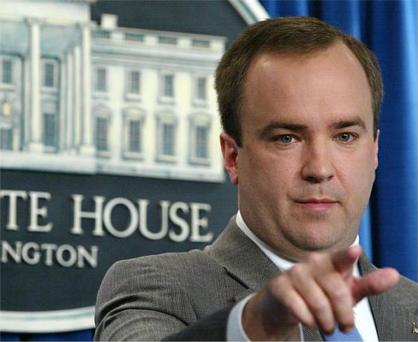
WH Press Secretary Scott McClellan

Despite the fact that the Chairman of the Joint Chiefs of Staff, Gen. Myers, said the article was unrelated to the violence in Afghanistan, the White House was able to redirect the spotlight away from the administration and its policies to Newsweek and potential "liberal" bias in the media. No administration supporter has been able to mention the name Newsweek without adding the words bias or propaganda for a week.

The administration chastised Newsweek for a culpability that even the top military commander denied exists, and the mainstream press (from NPR's Daniel Schorr to CNN's various anchors) has dutifully followed, writing breathless stories about Newsweek's guilt or innocence and the questionable role of confidential sources. Commentators and editors are falling over themselves to state that they will continue to hold themselves to a higher standard than Newsweek, lest they end up on the administration's bad side.

By turning the focus of the media back in upon itself, the White House has assured that editors will take even greater pains before printing controversial articles. In an administration that places secrecy and loyalty above all else, some of the only insight we will gain into internal debates or access to potentially illegal or unethical practices is through the use of confidential sources.

The administration has managed to turn attention away from its own policies and in the process has ensured an even less aggressive media.

- Murphy